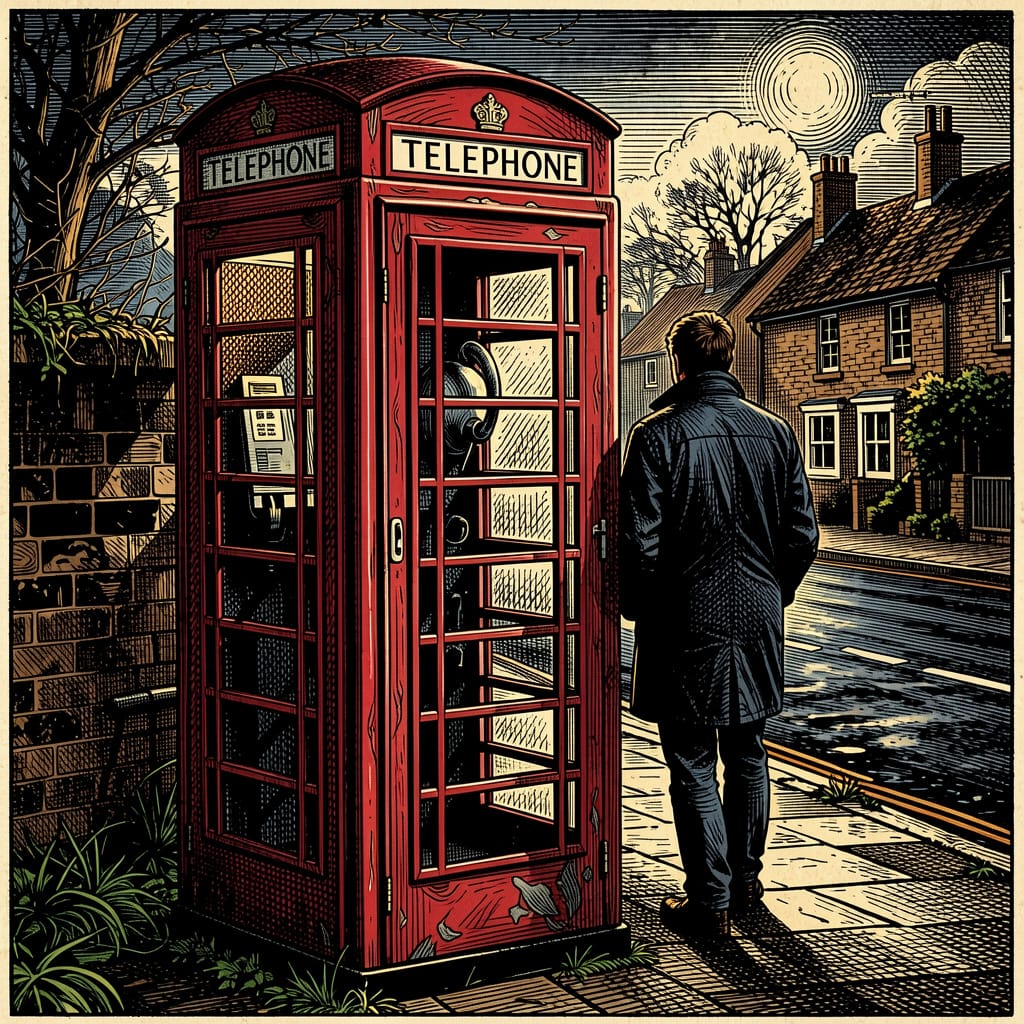
To Beowulf, the kiosk is a secure call relay. An agent reaches the line through a numerical protocol — a fixed sequence followed by a number that rotates on a weekly cycle, in the manner of a combination lock — and pays with ordinary ten-pence pieces, the clink indistinguishable from any villager's call. The line does not answer in the ordinary sense: it lifts to a deliberately engineered silence, beneath which the faint tick of a recording mechanism can be heard by anyone listening for it. Live contact is rare, and when it comes it is a single voice, anonymous, issuing clarifications in the clipped cadence of an encrypted conversation, ending without farewell.
The box appears in Chapter Ten: Beautiful Lie, where Declan Marsden uses it to file his report in the weeks after Robert's manifestation:
He dialled: six digits, then three, then a number that rotated weekly like the tumblers of a combination lock. The line rang. Once. Twice. Then lifted to dead silence — not empty, but deliberately void.
— Cambion, Chapter Ten: Beautiful Lie.
Declan reports the manifestation as contained: Orion's surveillance withdrawn as of Wednesday, a low-power static relay set up near Edale Cross, no secondary episodes, domestic containment robust. What he does not expect is the reply. His handler — a sharp, anonymous female voice — tells him there are two independent reports of a spike: one at the schoolyard, and one at the family's home on 10 November, filed independently by Phillip Lawson — Michael's father, an Orion signals man of currently inactive status. It confirms what Declan had only suspected: that Lawson had been watching the family on his own account before the schoolyard incident — that the incident did not draw Orion's attention so much as force it to show its hand.
The connection severs with a click. The coins stay where they fell, unclaimed, and Declan steps out into the wind's lee to steady his breathing. The kiosk's function in the saga is exactly this: to compress a great deal of consequence into a few minutes of clipped transmission, while the village around it goes on misting and barking and noticing nothing.